Entering a new ASEAN market sounds exciting until someone asks: "How much are we going to invest before we know this market actually works?"
For a global beauty or personal care brand, the obvious answer might seem to be building local manufacturing or packaging capacity.
But what if you're still testing demand?
Building facilities, purchasing equipment, hiring people, qualifying suppliers and holding inventory can be a significant commitment before you even know how much product the market will actually consume.
There is another way to approach the early stage:
Test the market first. Build capacity when the demand justifies it.
And for many brands, an experienced regional packaging manufacturer can help bridge that gap.
Do You Need Local Packaging Capacity to Enter ASEAN?
Not necessarily.
When entering a new market, the first goal is usually not to build the biggest operation possible. It's to find out whether the opportunity is real.
You need to learn:
- Will consumers buy the product?
- What price point works?
- Which channels perform?
- What packaging resonates with local consumers?
- How quickly can demand grow?
- Which ASEAN markets deserve further investment?
A market plan can give you assumptions.
Only the market can give you answers.
That's why some brands choose to work with an established packaging manufacturer during the initial stage, rather than immediately building their own local packaging infrastructure.
It allows them to enter the market with a more manageable level of commitment and adjust as they learn.
Packaging Isn't Just an Operational Detail
It's tempting to think of packaging as something that comes after the product and marketing strategy are already decided.
For beauty and personal care products, it can be much more important than that.
The tube affects how the product looks, feels and performs.
Depending on the product, brands may need to consider ABL, PBL, Co-Ex or plastic tube structures, barrier requirements, tube dimensions, printing, decoration and filling compatibility.
The right choice depends on the product and its intended use.
For example, a premium skincare product may have very different packaging priorities from a mass-market toothpaste.
And when entering a new market, the packaging may also need to reflect different consumer expectations and price positioning.
So the conversation with a packaging manufacturer shouldn't start with:
"Here's our artwork. Please give us a price."
It should start with:
"Here's our product and what we're trying to achieve. What packaging approach makes sense?"
That's a very different conversation.
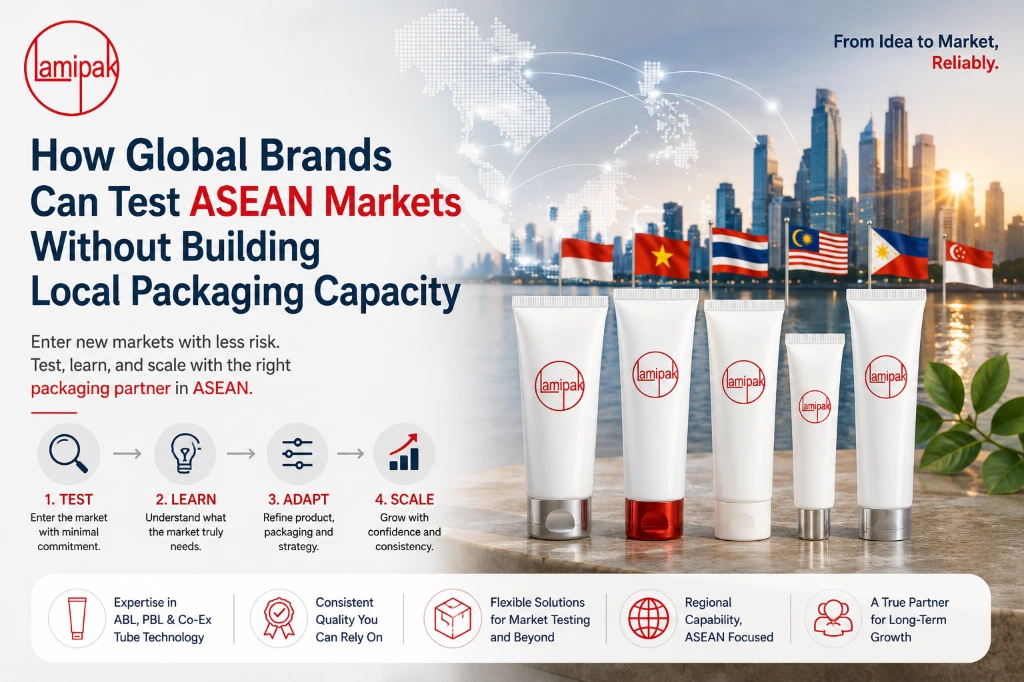
A Practical Approach: Test → Learn → Adapt → Scale
Instead of treating ASEAN expansion as a choice between "build locally" or "don't enter," brands can approach it in stages.
1. Test
Start with a manageable production commitment.
The objective isn't to maximize volume yet.
It's to see whether the market responds.
2. Learn
Look at the actual results.
Which products sell?
Which packaging works?
Which channels generate repeat purchases?
What volume is realistic?
3. Adapt
Use what you've learned to adjust the product, packaging, volume or commercial strategy.
This is also where flexibility from your packaging manufacturer becomes valuable. Artwork, specifications and quantities can change as the product develops.
4. Scale
Once demand becomes more predictable, increase production and investment with greater confidence.
The idea is simple:
Don't make a large operational commitment before you have enough information to justify it.
What Should You Look for in an ASEAN Packaging Partner?
If you're relying on a regional packaging manufacturer while testing a market, price shouldn't be the only consideration.
Technical capability
Can they support the tube structure, dimensions, printing and decoration your product requires?
And more importantly, can they help you understand the trade-offs?
A good packaging discussion should leave you with a clearer answer, not simply another quotation.
Consistent quality
A market test can become a successful launch surprisingly quickly.
Your first order may be relatively small. Your next order may not be.
The manufacturer needs to be capable of maintaining the agreed specifications as production grows.
Flexibility
New markets rarely behave exactly as expected.
Volumes change. Artwork changes. Products change.
A packaging manufacturer that can adapt with you can make the early stages much easier to manage.
Regional capability
ASEAN isn't one market.
Indonesia, Thailand, Vietnam, Malaysia, Singapore and the Philippines have different consumers, channels and commercial environments.
A regional partner should understand that market entry is a process, not simply one shipment.
Ability to scale
The partner that supports your first 20,000 or 50,000 tubes should ideally be capable of supporting you when demand reaches a much larger volume.
Otherwise, you may have to solve your supply chain all over again just when the product starts taking off.
Where Does Lamipak Fit?
This is how we see our role.
Lamipak isn't only a tube manufacturer.
Our ambition is to become ASEAN's Trusted Turnkey Beauty Partner, helping beauty and personal care brands move from idea and product development through packaging, manufacturing and ultimately into the market.
For a brand entering ASEAN, that means looking beyond the individual tube.
The journey is connected:
Idea → Product → Packaging → Manufacturing → Market → Growth
A packaging decision made at the beginning can affect what happens later in production, filling, distribution and scale-up.
That's why we believe in Trusted Executions.
Not simply providing a packaging specification, but helping turn an idea into something that can be executed consistently in the real world.
You Don't Have to Build Everything on Day One
There isn't one correct market-entry strategy for every global brand.
For some companies, establishing local packaging capacity will eventually be the right move.
For others, working with an established regional manufacturer may provide the flexibility needed while the market is still being tested.
The important question isn't:
"Should we build or should we outsource?"
It's:
"What level of commitment makes sense for our business today?"
If you're entering ASEAN for the first time, you may not need to have every answer before you begin.
You need enough capability to test the opportunity, learn from the market and scale when the numbers justify it.
From Idea to Market, Reliably.
Considering an ASEAN launch?
Talk to Lamipak about your tube packaging requirements, product concept or regional market-entry plans.
[Explore Tube Packaging Solutions]